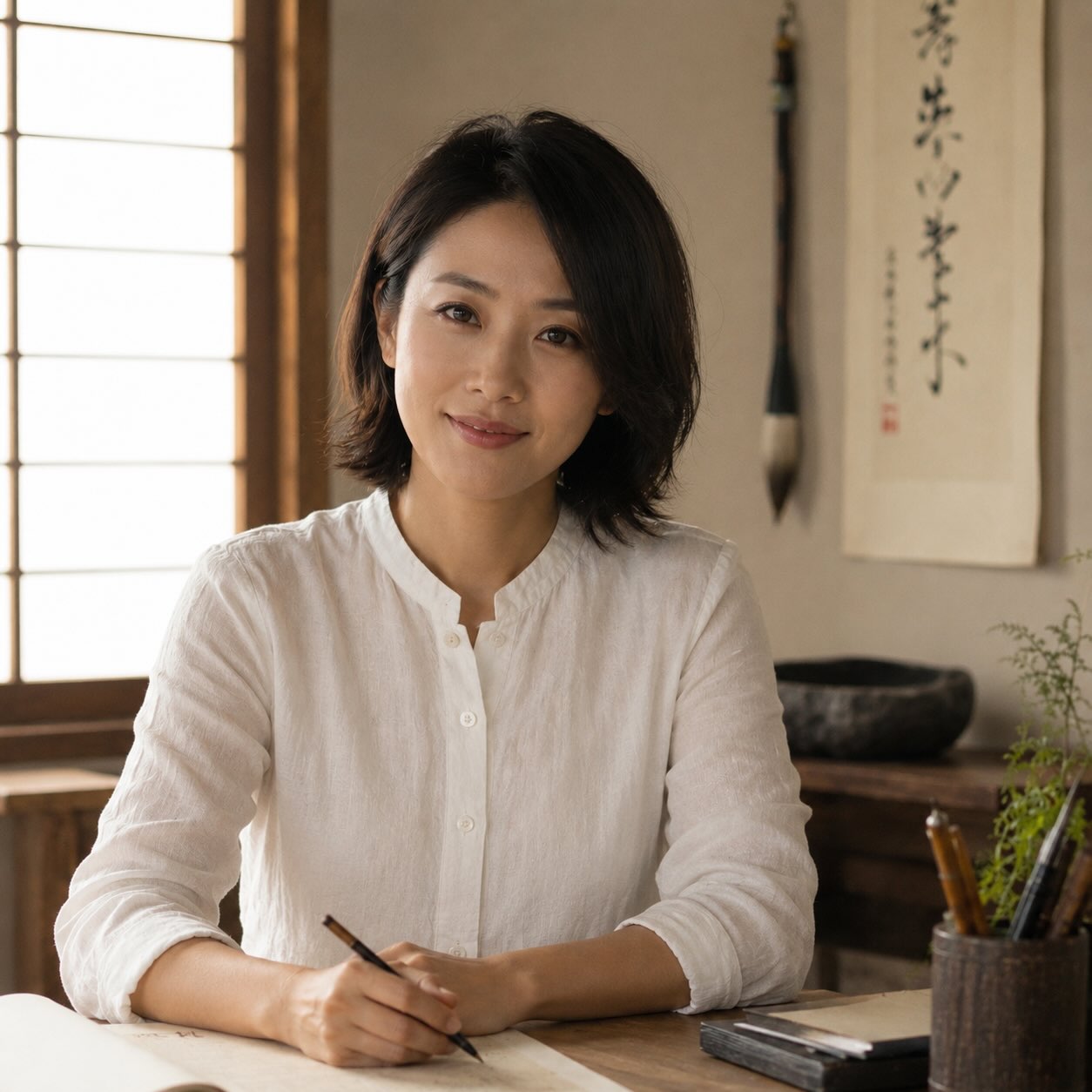
The first envelope took forty minutes.
We were getting married in a small ceremony — 180 guests, one calligrapher (me), and a stubborn refusal to use a printed font on the invitations. I had been writing brush characters on weekends for years, mostly for my own diary, never for anything that mattered. The first envelope had three crossed-out drafts inside. The second took thirty minutes. By envelope eighty I was finishing one every six minutes, and my right wrist was a quiet, permanent ache.
When the last envelope went into the post, I thought: I just spent ninety hours making each guest's name look like it was written for them. It was the most romantic thing I had ever done. It was also completely insane.
A friend who runs a small bookstore asked me, half-joking, if I could "just make a font out of your handwriting." I told her sure, easy, give me a week. That week became a year.
What I actually learned in that year
I learned that the real font-engineering world is unfriendly to people like me. Existing tools assume you have either (a) a typography degree and FontLab Studio, or (b) a full research budget. The few "handwriting-to-font" services that exist either need you to fill out a 6000-character grid by hand (no), or output something that looks like Comic Sans wearing a costume (also no).
I taught myself zi2zi, then deepvecfont, then a stack of diffusion-based character generators I had to read four AAAI papers to understand. I learned that the gap between "a model that produces beautiful single characters" and "an OTF file that opens in Microsoft Word" is roughly six weeks of FontForge scripting and one understanding of why importOutlines flips the Y axis. I learned that the Chinese script has 6500 commonly-used glyphs and that "commonly" is a polite lie — the long tail of rare characters is where every model I tested fell over.
I also learned the thing I was actually trying to find out: a personal font, made from your own hand, feels different. Not better than a professional typeface — different. It carries a person inside it. A diary written in your own font reads like your own diary. A wedding invitation set in your fiancé's handwriting feels like a small private gift.
What MoFont is, in one paragraph
MoFont gives you a printable A4 grid — fill it with your own handwriting in ballpoint or brush, then photograph it (thirty to fifty characters in total) — and hands you back an OTF and TTF file covering the full 6500-character common set. The training takes about three to four hours. The price for a personal license is what a nice dinner costs. There is no subscription, no watermark, no "upgrade to remove our branding from your font name." It is yours.
The whole product is the answer to a question I kept asking myself on envelope ninety: Why is it that a printed typeface costs nothing per use, but a font that looks like you costs nothing that exists?
Who I'd like to make this for
I'd like to make this for the woman who is writing her grandmother's recipes into a real cookbook for her cousins. For the small ceramicist who wants her studio name on the bottom of every cup in her own hand. For the high school teacher who wants the worksheets to feel like a letter, not a memo. For anyone, really, who has ever wished their writing could be everywhere they needed it to be without their wrist hurting.
I wrote the first version of this product the same week I finally let my wrist rest. If you try it, I'd love to know what you make.
— Iris